Your cart is currently empty!

Review Score:
D-
October 3 / 2025 –
I approached this album the same way I approach looking for food when I’m drunk at 1:00 AM on a Saturday: just about anything would taste good. But I open the pantry doors and find a box of store-brand minute brown rice and a can of green beans, and I go to bed hungry instead.
That about sums this up. My expectations were intentionally low in the hope of finding something to enjoy, and yet here we are.
I’m not here to jump aboard some kind of Swift hate train or anything. I never go into an album hoping to dislike it. But when your net worth surpasses the billion-dollar mark, I lose the ability to sympathize. So if this comes across as harsh, just know that I know that.
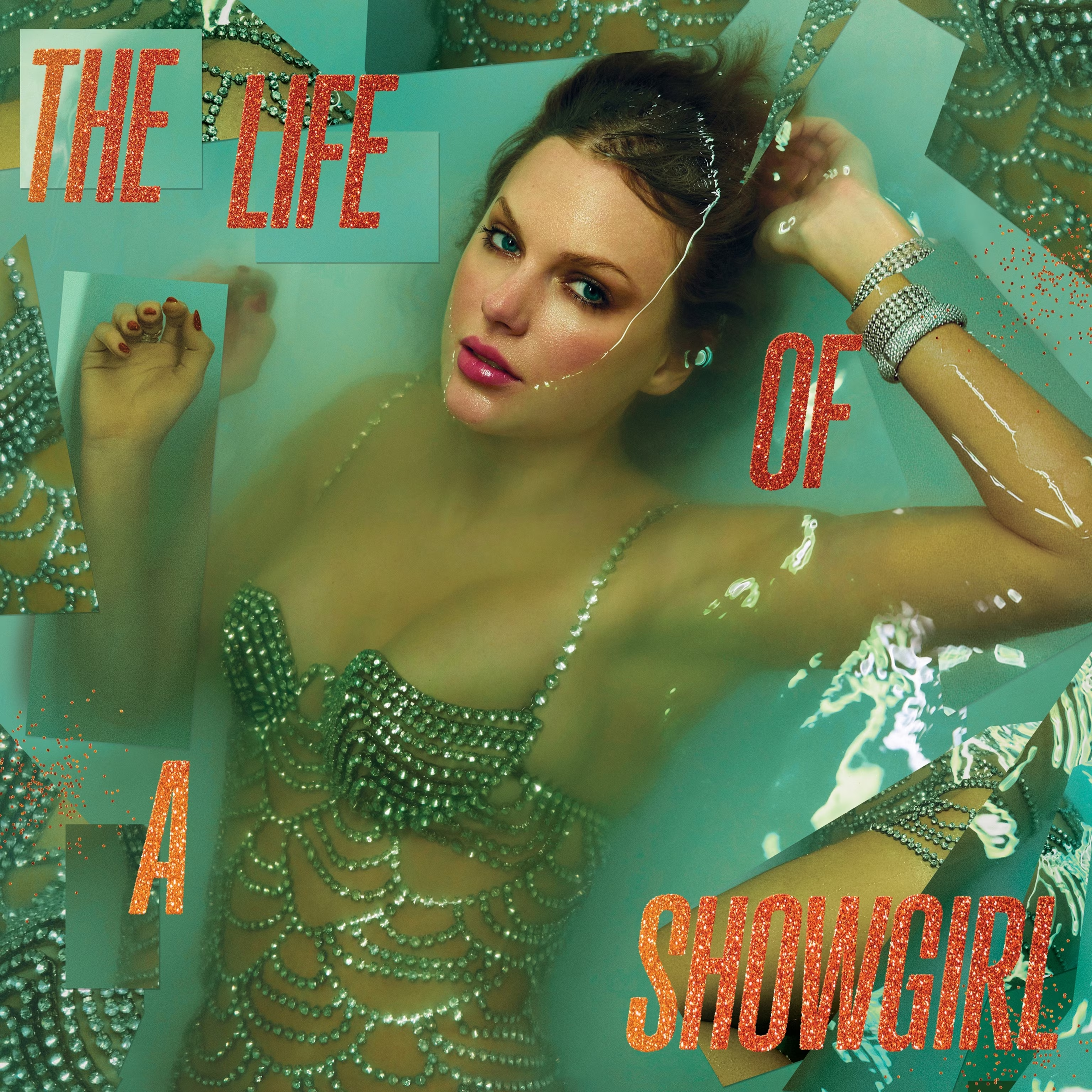
Recorded on the road during one of the biggest and most successful tours of all time, The Life of a Showgirl follows one of Swift’s most successful album cycles to date. This is assisted, technically speaking, by some very intentionally timed alternate versions and bonus tracks. Even setting that aside, this is still the peak of Taylor Swift’s already very successful career.
And yet, on The Life of a Showgirl, Taylor Swift may as well be admitting that the folklore/evermore era was some kind of mirage. The writing on her newest album is a far cry from the bare and bittersweet poetry she composed just a few short years ago. I’m removed from the Twitter discourse of this album at the moment, but I’m certain I would not be the first to call this “AI Taylor Swift material.” And I don’t just mean that in the typical sense.
A few years ago, as AI art was really beginning to take off, I read a study (or rather, just the headline of a study) claiming that AI art was beginning to learn from other AI art. As a result, the product became diluted, like a picture of a picture of a picture. The quality eventually diminishes so much that the original is no longer identifiable. I wouldn’t say we’re quite there yet with Taylor Swift, but we’re close.
More accurately, the end result of Swift’s newest album cycle feels like a game of telephone played amongst children at a sleepover. The sentence passed between a dozen preteens becomes something completely different at the end, much to their amusement.
Swift’s writing brain, for lack of a nicer way to say it, is fried. That’s how we end up with lyrics like these:
“We were royalty in a cheap hotel
Dazed and confused, but we clean up well”
Oh wait, sorry, that’s actually from the latest MGK album lost americana. I meant to include this:
“I had a bad habit of missing lovers past”
and
“I thought my house was haunted, I used to live with ghosts”
Maybe you can forgive my confusing the two. Credit to MGK, though, his latest album is at least based on obvious influences, for better or worse. With Taylor Swift’s last handful of albums, I’ve begun to wonder if she actually has influences outside of her own past work.
Take a look at other pop records from major artists, like Harry Styles’ Harry’s House, for example. It is largely distinct from Fine Line, the album that preceded it. There are interesting choices made, unique sounds chosen, and a clear vision for the final product. In a later interview, Styles explained he was inspired by Haruomi Hosono’s 1973 electro-pop album, Hosono House. Or take the more recent Sabrina Carpenter album, who appears on the final track of this project. Say what you want about Carpenter, but it would be disingenuous to claim she didn’t have a sound and a vision.
Yes, it seems like Taylor Swift has been drinking her own Kool-Aid for some time now. The most inspired choice on this album was a diss track for none other than current pop queen Charli XCX. Why you would call attention to one of the most talented pop artists working today (on this album, the musical equivalent of biting into a piece of bread you later discover is moldy) is beyond me. Several reviews call this album Taylor’s most “adult” yet. CNN, for example, said she is “in her grown-woman era” (Swift is 35).
Of course, by “adult,” they don’t mean mature. Because any self-respecting musician would have left the song about Travis Kelce’s dick on the cutting-room floor. Side note: that same CNN article also said the following:
“Suffice it to say, Kelce must have impressive moves off the field.”
If only he had those same moves on the field, the Chiefs might actually have a winning record right now.
Truly, “Wood” is a waste of the album’s only good production. It’s catchy until you have to start holding back vomit. Then Swift goes on to write about cancel culture. Somehow, she found a way to make something even more lyrically upsetting than a song about a penis.
Taylor Swift commenting on cancel culture is like an uncontacted Amazonian complaining that kids are on their phones too much. Nobody has ever been in less danger of being canceled than Taylor Swift. So much so, in fact, that even chronically online little old me had to stop and research what she could possibly be talking about.
Thankfully, one lovely contributor over at Genius Lyrics had this to say:
Swift has unfortunately had a history with cancel culture, beginning in 2013, when things heated up due allegations of her “serial dating.” After her feud with Katy Perry, and despite the success of 1989, Swift was getting labeled as calculated and manipulative. After Calvin Harris went on a Twitter rant about Swift, #TaylorSwiftIsOverParty became the #1 trend on Twitter, leading to Swift’s “cancelling.” Not long after that trend, Kim Kardashian released snippets of a phone call between Swift and Kanye West, which showed that Swift gave West permission to be called a “bitch” in his song “Famous,” despite her having continuously denied that she did. (In 2020, it was revealed that there was more to the phone call and Swift, in fact, did not give permission.)
“Serial dating.” That link, by the way, takes you to the Linfield Review, a student blog for a university in Oregon with fewer than 2,000 students.
I’ve long known about Kanye West and heard snippets about the rest of this drivel. Swift could barely be bothered to endorse Kamala Harris in the last presidential election cycle, doing the bare minimum in a one-off Instagram post. And yet she has more than a few songs about drama and cancel culture in her catalog.
I’m losing the plot here. Let’s talk production, handled by Swift alongside Max Martin and Shellback. This is the same trio responsible for Reputation and 1989 (Taylor’s Version). I have my issues with both of these previous works, the latter of which fails to capture the same quality of the original.
Anyway, these songs sound unfinished, unpolished, and uninteresting in almost every case. It’s really a footrace on each and every track between some of Swift’s worst lyrics and the Swedish duo’s worst production. But in this race, there are no winners.
I took a break from the album, which had me feeling like I’d just gone several rounds with prime Mike Tyson. I felt like I’d been punched a hundred times. Every line had the potential to make me wince and flinch. This all sounds like hyperbole, and it mostly is, but when I finally reached the album’s title track (the final one), I stopped after the first verse and said out loud: “oh fck.”*
“Her name was Kitty
Made her money being pretty and witty
They gave her the keys to this city
Then they said she didn’t do it legitly”
No, Google Docs, that is not a grammatical error on my part, so you can lose that red squiggly line. That’s just what Swift and her team felt was the best rhyme scheme, all of it just to end with the word “legitly.”
This song’s bridge is what I had expected, maybe even hoped, the whole album would sound like. It embodies the musical theater sound and cadence that the album’s title implied. Short of this track, nothing here is actually unique in terms of sound.
Sabrina Carpenter, perhaps I’ve judged your work too harshly. In fact, I need to issue a formal apology to all pop artists whose albums I’ve reviewed poorly of late. Because this is the worst pop record I’ve heard this year. I’m certain there are worse ones. But the real punch in the gut is the difference between potential and output. Taylor Swift has a hundred good songs. I return to them fairly often, in fact. And I am far from her target demographic. But this is really some of her worst work, possibly ever.
Review Score:
D-
Gubb wrote this review. You can’t get mad at Gubb.
Leave a Reply