
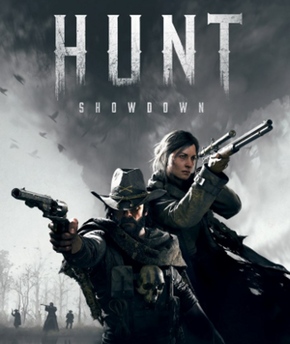
The Undeath of Hunt Showdown
The amount of realistic experience a consumer is meant to experience from any given game varies wildly. In the age of the live service title, that number can easily reach the hundreds of hours over the course of several years. But few players leave a game they’ve enjoyed for so much time with a good taste in their mouth. Check the negative reviews of any given title on Steam and you’re bound to find a long-winded, negative review whose writer has logged 1000 or more hours. You might see this and ask yourself how someone could play so much of a game they ultimately can not recommend. Like any relationship, the answer to that question is complex.
And a relationship with Crytek’s Hunt: Showdown is one destined to break your heart.
I’m one of these multi-hundred hour, negative reviewers. One of those poor, lost, confused souls who invested so much time into a game I can not recommend. But the reason isn’t because I’m a sadist who forced myself through those hours. If I can be facetious for a moment – like many others in these tragic relationships, Hunt: Showdown isn’t the woman I married.
Hunt: Showdown – which actually has been rebranded as Hunt: Showdown 1896 – was originally known as Hunt: Horrors of the Gilded Age. This was back in 2014, and that game was actually a completely different title than what we ultimately got in 2019. HotGA was a third-person, cooperative horror game. After a shuffle within Crytek, development of Hunt was shipped back to Germany and away from the USA studio. Three years later, Hunt re-emerged with a new vision. The game would finally see a full release in 2019 after years in early access.
Hunt: Showdown was long considered a niche title. Despite bearing many similarities to your average battle royale, Hunt was actually an “extraction shooter”. Though the idea is to be the last man, duo, or trio standing in a match, players are free to cut their losses and flee to the edges of the map for “extraction” at any given time. Players share a common goal of reaching the map’s “target” (or “targets”) – a horrific monster to be slain. There’s no “storm”, no ever-shrinking circle to encourage a final showdown, and no “victory” screen for the winner. On extraction, you’re greeted with a singular message “you live to die another day”.
Canonically, Hunt: Showdown is a series of theoretical “showdowns” between bounty hunters in late 19th century Louisiana. The grimy swamp aesthetic was one of the game’s more unique qualities. Especially in the early days of the game, the gothic appearance of your surroundings really immersed the player. The weaponry was (mostly) era appropriate. Rifles were limited in their ammo capacity and took a while to load. Your sidearm was less effective, and required precise gunslinger aim to truly succeed with. This slower, more methodical approach to gunplay made the fights feel very visceral. Though rushing in guns blazing was sometimes successful, your actions usually required more thought.
And because it was an “extraction shooter”, characters and gear carried over from game to game (assuming you made it out with your life). A successful hunt meant more credits, which you could exchange for fresh equipment for your next outing. Actions in the world, kills, bounties collected, etc, would yield experience for your character and allow you to dip into some of that swamp magic and apply various traits to your character. Maybe you want to walk more quietly, frighten fewer animals, and take less damage from fire. Up to a point, your character was a reflection of your success on the bayou. “Legendary Hunters” were skins you could acquire with “Blood Bonds”, a secondary currency common to live-service games. But in the early days of Hunt, they were commonly found in hiding spots throughout the map or as rewards for various events or achievements. So purchasing one of these Legendary Hunters never felt too far out of reach as a player if you didn’t feel like breaking out your credit card and using real money.
The game’s most unique quality, however, was the sound design. For all its bugs and performance issues, the sound design always felt “next gen”. From the crack of a tree branch, to the crunch of broken glass near a broken window, every movement made noise. No matter how subtle, you were never truly undetectable. There was always a unique balance to the quiet approach and a lingering desperation that your opponent would run out the back door and make off with your prize before you arrived. This meant a different engagement in every location, in every game, with every player. Your equipment would play a factor in how you chose to engage with an enemy. Maybe you brought a scoped rifle, but your ally brought a shotgun. You want to take a position on a rooftop, but do you dare separate from your friend as they go in close?
The game launched with a single map and a single boss. Yet in any given game, there were countless choices to make.
And here we are in 2024. The game has been rebranded as Hunt: Showdown 1896 after Crytek announced a full engine upgrade to overhaul the game. With it, they released a new map set in Colorado – which would allow for more unique terrain than what players were accustomed to. The game went offline for 48 hours. When it returned, the player count spiked as gamers rushed back to see what Crytek had cooked up for them. The results were…less than extraordinary.
______________________
Hunt has seen its share of ups and downs over the years. Despite 5 years of its existence, that single map and single boss has only expanded to four maps and four bosses (six if you could “wild targets”).
At the launch of the new engine, fans were overwhelmingly disappointed with the embarrassingly subpar user interface. The previous iteration never truly shined. Over the years, Crytek had added tab after tab to the original UI without condensing or restructuring it. I had played for years and even I had issues finding anything outside of the main character selection screen. The game’s engine upgrade was pushed as a new era for Hunt. Ideally, it would have attracted and retained a large swath of new players to ensure a stronger future for the game. Unfortunately, players new and old were greeted with one of the worst UIs I have ever seen. It was nearly incomprehensible and largely thought to be leagues worse than the previous version.
Immediately, Crytek course-corrected. One of the main promises under the new rebrand was an overhauled user interface. It was a problem long acknowledged to be one of the game’s issues – and it was somehow made even worse than before. They announced a change would be coming soon.
As for the new map, it was well-received. Colorado proved an interesting setting for a Hunt location and, hopefully, opened the door for a variety of others in the future. The team at Crytek was slow to release maps, but those maps usually did not disappoint.
Players who were eager to see how the engine affected their other favorite maps were left disappointed. As part of the Cryengine 2.0 update, the other three maps were removed from the game. Slowly, they would be reintroduced after further upgrades and polishes were made to them. So, with nothing but the new “Mammon’s Gulch” to explore, players began to notice some issues. Invisible walls, unrendered pixels, and frame rate issues plagued the new Hunt: Showdown 1896. Though the game did see a boost in total players for a short time, those numbers have since dropped back to the levels they were at 1-2 years ago. Needless to say, the launch of Crytek’s new era for the game did not go quite as planned.
The road to Hunt: Showdown 1896 was not without its bumps either. Over the years, the game has undergone some changes. As I said earlier, Hunt is not the woman I married.

The UI prioritizes in game purchases over anything else.
Think back to that thoughtful gunplay I spoke of. The game launched with a handful of weapon choices in varying categories. Rifles, shotguns, pistols, and melee weapons were your options. And players had to balance those choices carefully to ensure they had what they needed. If you took a shotgun, you could balance that loadout with a mid-range pistol. If you took a single shot rifle, you could opt for something at a lower range and higher fire rate for close encounters. Various traits would change things up, allowing the player to balance different combinations of medium and large slot weapons (back in the day, players could take two large slot weapons with the right trait – a feature that is being reintroduced).
In the modern era, however, Hunt offers a much wider weapon selection. At the time of writing this article, there are 124 different variations of rifles, pistols, shotguns, melee weapons, and the odd bow or bomb-lance. If you remove variants from the equation, it probably cuts that number to a third of the total. Allow me to get into the weeds for a moment.
It used to be that each weapon filled a niche. If you wanted a shotgun that had the capacity for multiple shots before having to reload, that option was there. Now, that option could mean the Specter 1882, the Winfield 1893 Slate, the Crown & King Auto, or the Winfield Terminus. Previously, your single shot shotgun was the Romero. But now, there’s the Romero Alamo, a multi-shot version of that single shot version. If you wanted to throw variants into the mix, that list expands to include the Winfield Slate Riposte, and the Specter Bayonet. This list doesn’t include the medium slot versions of those weapons.
Ok, let’s talk about rifles. Hunt includes small ammo, large ammo, medium ammo, and special ammo. But it also now includes custom ammo for every individual weapon. Say you want a small ammo rifle. Historically, that meant a larger ammo capacity, but less overall damage and range. Your options are the Caldwell Marathon, Caldwell Marathon Swift, the Winfield M1873, the Winfield M1873 Swift, the Winfield M1873 Musket Bayonet, the Winfield M1873 Aperture, the Winfield M1873 Talon, the Nagant M1895 Officer Carbine, the Nagant M1895 Officer Carbine Deadeye, the Winfield M1873C, the Winfield M1873C Marksman, and the Winfield M1873C Silencer.
Imagine the experience of one of Crytek’s coveted newcomers to the game. You hear about the engine overhaul and finally bite the bullet and purchase Hunt. You launch to a mystifyingly messy user interface with no understanding of the game up to this point. You hopelessly select your equipment with no understanding of the niche they fit into, and enter a bug plagued mess of a map and watch your frame rate dip lower than it would have prior to the engine update.
I suppose you shouldn’t worry about the weapons though. The era of weapon niches in Hunt is over.
Like any live-service title, Hunt fell prey to the microtransaction market. The team began to pump out character skins at a faster rate than ever before prior to Cryengine 2.0. Players would note that a particular skin offered an unfair camouflage advantage. Posts would stack up on the game’s Reddit page until the developers finally acknowledged it and all the players who purchased the skin due to the unfair advantage would get angry about the change. And then just a few months later, another problem would arise just like the old one. Rinse and repeat.
And of course, the bugs. Hunt has never been bug free. Each time a patch would be released, the list of known issues grew longer and longer, frequently beating out the list of actually solved issues. Poor hit registration, death trades, cheaters, lighting glitches, texture issues, poor UI, crashes, disconnects. The list goes on. These bugs are all still consistent issues within the game. Sometimes they are pushed beneath the metaphorical bed of Crytek’s messy room, but eventually it gets so full underneath that issues tumble back out into the fray. It’s cyclical, never truly seeing an end to the performance issues.
For years, the main complaint about the game was the servers. “Fix the servers”, they would say. Some comments would say “they can’t, it’s a contract” in reply. But eventually, the servers did see changes, and disconnecting from a match became more of a rarity than ever before. But the dreaded lag, packet loss, and high ping would see a return with the new update. Console players, the constant punching bag of the Hunt: Showdown world, are finding their complaints largely ignored once more as they experience worse issues than PC gamers. The previous iteration of Hunt on Xbox One and Playstation 4 ceased to exist with the new update, as the older tech was said to be incapable of handling the graphical leap the title would take on release. Owners of those games would now have to jump to a new console, if they even owned one. And a new version of the game, if they felt like forking over the money again. This isn’t to say that the game isn’t fairly priced. Which brings me full circle back to where I began.
How much time can you get from a game before it’s fair to say you’ve gotten all you can out of it? In the era of constantly evolving live-service titles, your favorite games are subject to change. Fortnite, Overwatch, these are games that have been completely altered by updates over time. Has Hunt now joined the list? Take a look at the reviews for the game. On Steam, they’re “mixed” as of late. Who’s leaving positive reviews? Players with anywhere between five and five hundred hours. But the bad reviews?


Is the game dead? No. Far from it. I expect Crytek to milk Hunt for as long as people will purchase things within the game. Realistically, it’s all they have in their lineup of any worth. Unless Crysis 4 draws a large audience, Crytek needs Hunt. But to make it last, they need to listen to people who have stuck with the game for more than one-thousand hours. On average, 32.7% of games in people’s Steam library are unplayed. An even larger percentage are not played beyond the tutorial. Crytek needs its player base. And to maintain it, they need to start listening closely.

Leave a Reply